The Others (2001) is a gothic psychological thriller that explores concepts of truth, deception, and what secrets lie beyond the ring of light we cast around ourselves. Chile-born Alejandro Amenábar wrote, directed, and scored the film, which stars Nicole Kidman, Christopher Eccleston, and Elaine Cassidy. By analyzing the movie’s lighting style, cinematic techniques, and costume design, the viewer gets a deeper look into this psychological thriller, specifically how it inquires whether bringing things to light is always a wise decision.
The film’s narrative revolves around Grace, (played by Kidman) a devout Christian woman who struggles to raise her two photosensitive children as she awaits her husband’s return from World War II. The arrival of three housekeepers and invisible intruders to their secluded English estate catalyzes the family’s psychological downward spiral. Upon hearing distant voices, music from a closed piano, missing curtains, and doors that open and close on their own, Grace begins to question her sanity and turns on her children, Anne and Nicholas. At the film’s climax, Grace fights the housekeepers and the intruders to protect her children. In doing so, she realizes that not only is she dead, and that the invisible intruders are living people touring her home, but that she smothered her children to death after learning that her husband was killed in the war. The film concludes with Grace and her children vowing to stay together as a family in the house, with the words “This house is ours,” echoing through the empty, darkened rooms as the living family vacates the haunted house.
Lighting
The most apparent cinematic element that director Alejandro Amenábar plays with is lighting. Light, how characters interact with it, and how it interacts with them greatly impact the story. The main character’s children, Anne and Nicholas, suffer from xeroderma pigmentosum, a skin condition that causes blisters to the areas of skin that have been exposed to too much light. Because of this problem, Grace must interact with her children only by candlelight. This limited lighting has very interesting effects on both the characters and story.
Candles and candlelight are essential props to this film, and are used throughout, as seen on the movie’s title image.
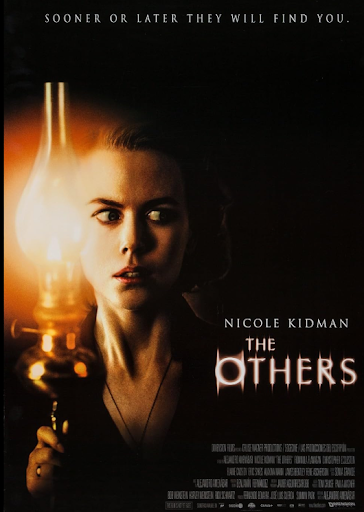
As Grace holds the candle at eye-level, sharp shadows distort her features in a chiaroscuro effect. One half of her face is in darkness, while the other is illuminated. This cinematic choice of relying heavily on candlelight not only lends a creepy, gothic aesthetic but is also metaphorical. This effect exemplifies how the main character and her children are “in the dark” about many things: their husband/father dying in the war, the housekeepers’ deaths, their own deaths, and that the intruders are living people. This half-light and half-dark effect is also symbolic of the fact that the main characters straddle two worlds: the living and the dead.
On another note, the single candle that Grace carries from room to room is a symbol of her faith. As seen from her multiple Bible lessons with her children, Grace is a very religious woman. After the war ends and she has not heard about the fate of her husband, she clings to her faith, all the while knowing that she will have to raise Anne and Nicholas by herself. A metaphorical darkness settles around her and she uses her faith to guide her along, much like she uses the candle to guide her through the darkened hallways of the house. By taking advantage of the commonplace candle, the director creates beautifully mysterious lighting that complements the narrative.
Cinematography
The director’s choice of camera movement also has a large impact on the viewer’s interpretation of the story. There is a scene half-way through the movie that features Anne sitting on the steps of a staircase, reading the Bible as penance for frightening her younger brother. From a different room, Grace hears strange noises and comes to check on her daughter. The two exchange harsh words, but Anne eventually concedes and tells Grace that the noises originated from the junk room upstairs. The camera pans up from Anne and Grace to a low-angle shot of the junk room door. Even with the door closed, slivers of light shine around three sides of the door and slice through the darkness.
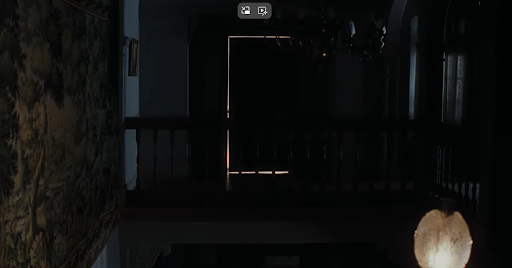
Having the light come into view gives the implicit meaning that something behind the door (possibly the intruders) will adversely affect the unruffled darkness in which the family lives. After all, in this narrative, it is light–not darkness–that is dangerous. This shot, accompanied by the non-diegetic sound of creepy music (featuring the moaning, ghost-like, voices of a chorus that finish with a squealing crescendo) inspires fear, discomfort, and curiosity in the audience.
Later in the film, Grace finds a black-and-white photograph underneath one of the housekeeper’s beds. A close up occurs as her expression changes from confusion to horror.
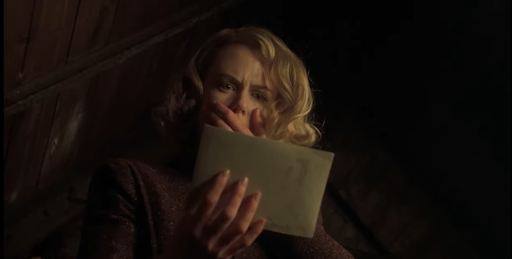
The shot switches to the focus of her attention in the form of an eye-line shot, and the audience sees the cause for her reaction: the photograph shows three individuals sitting with their eyes closed and heads lolling. However, they are not simply sleeping. The viewer knows from an earlier scene that this is a post-mortem photograph.
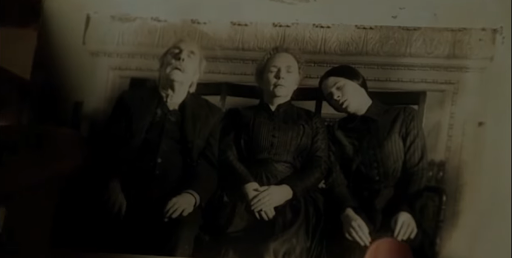
As the frame slowly slides from left to right, the faces of the current housekeepers Mr. Tuttle, Mrs. Mills, and Lydia cannot be mistaken. The tight camera frame brings light to details that the viewer has not known prior to that moment. The truth, symbolized by the extreme close up, feels suffocating, which the viewer experiences alongside Grace. Both the viewer and Grace are forced to bear witness to the awful revelation that the housekeepers died long ago and cannot escape it. By means of camera movement, the director adds subtle hints about the characters and storyline.
Costume Design
Additionally, the director conveys information by costuming the actors in certain clothes. Each piece of clothing is chosen for a reason and offers insight about each character. For example, Grace often wears dark clothing.
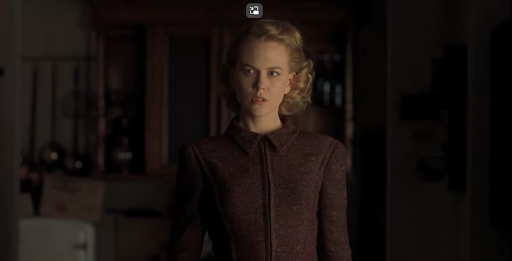
Whether it is the burgundy button-up dress seen in the exposition, or the dark purple sweater that she wears when she checks on Anne, Grace’s costumes are almost always dark in color. The limited light accentuates these colors by making the burgundy a deep, dark red and turns the purple into a sickly black. Having the actress don dark-colored clothing represents her mentality. Because of her children’s condition, she must live in a world of darkness. She has learned to embrace the shadows (metaphorically and physically) and feels negatively toward the element of light. This inclination is seen when she notices that all the curtains in the house have been taken down and hidden. “The curtains!” she shouts frantically to Lydia and Mrs. Mills, “The curtains my children’s lives depend on! Someone has taken the curtains!” Mrs. Mills remains calm, but Grace cannot be placated. Without the curtains, Grace feels she cannot keep her children safe. She has been stripped of her primary weapon against the sunlight that she swears will kill her children. In this scene, the actors’ wardrobe reflects their psychological states. Grace wears a dark burgundy housecoat, while Lydia, the housekeeper whom Grace rushes to first for answers, wears a light gray smock. Although Lydia cannot speak, her wardrobe communicates volumes. She is aware of her status as a ghost, so she wears light-colored clothing throughout most of the film. By contrast, Grace favors darkness and is “in the dark” about herself being a ghost, so the actress wears dark clothing.
One of the few instances in the film that Grace wears light-colored clothing is when she and her husband are alone. Anne has told her father about “the day Mummy went mad,” which the viewer later learns is the day Grace killed her children and herself. Therefore, the father is shown in light beige-green clothes.The light at his back through the windows highlights these colors. He knows he has died and has just learned that his wife and children have suffered the same fate.
As her husband explains that he will not be staying with his family, Grace removes her dark robe and dress, revealing a cream-colored slip.
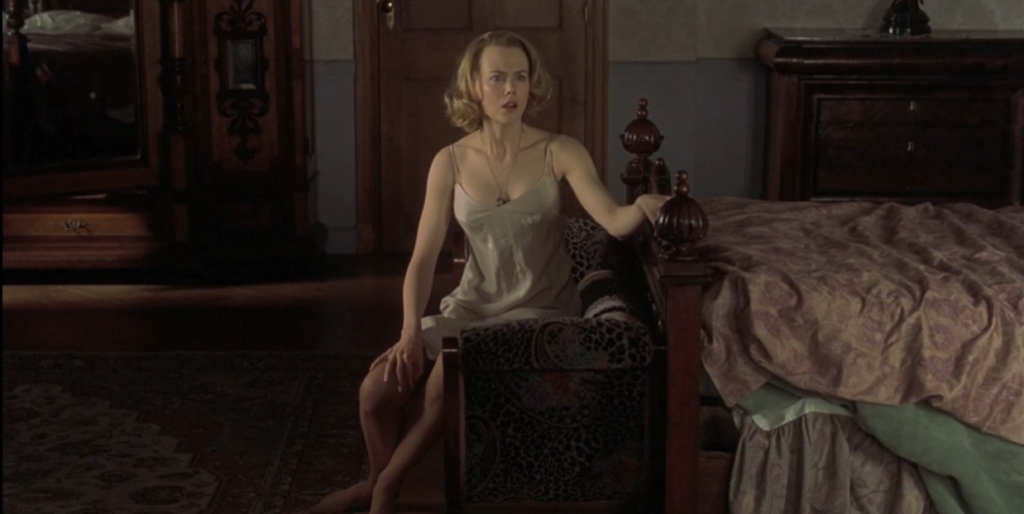
While the whereabouts of her husband have been “brought to light,” she is not pleased with his decision to leave. She struggles a great deal with this information. In this moment, the character is extremely vulnerable—the light coming in through the window, her light-colored clothing, and her lack of layers support this fact. The manipulation of costumes to reflect the character’s mental state proves to be one of many tools that the director uses to add subtle details to the narrative.
Conclusion
The Others is a psychological thriller that still manages to shock audiences with its beautiful, yet tragic story 25 years later. Although he was young when he directed the film, Amenábar was more than capable of bringing his vision to life. By means of innovative lighting techniques, creative camera movement, and thoughtful costume designs, the director entrances viewers and plays with a very human curiosity of what secrets lie within the darkness and what light is able to reveal.